
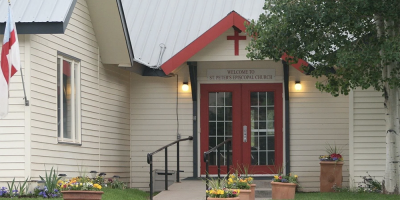
St. Peter’s of the Valley Episcopal Church, Basalt
How Saint Peter’s of the Valley Steps Into the World
By the Rev. E. Wendy Huber (Trachte-Huber), Rector, Saint Peter’s of the Valley, Basalt, Colorado
There is something about a red door. Every Episcopal church seems to have one, and I am told the tradition goes back centuries — a sign of sanctuary, of welcome, of holy ground. Saint Peter’s of the Valley in Basalt has red doors too, and we love them. But somewhere along the way, we asked ourselves a harder question: What happens beyond those doors? What is the church when it walks out into the world it was made to serve?
“Beyond the Red Doors” isn’t a program at Saint Peter’s. It is a posture. It is the way we understand what it means to be church in the Roaring Fork Valley in this particular moment in history — a moment when our community is changing fast, when the need is real, and when the Spirit seems to be saying, loudly and insistently, “Get out there.”
We are a young parish — one of the younger in the Episcopal Church in Colorado — and we are small. We are also scrappy and, I would argue, mighty. We do not have the resources of older, larger congregations. What we have is location, people, and a deep conviction that the Gospel was never meant to stay indoors.
One of the gifts of a congregation like ours is who shows up on Sunday. Lindsay Lofaro, the executive director of the Buddy Program, is one of our own — and her daughters are third-generation Saint Peter’s members, a remarkable thing in one of the valley’s youngest parishes. The Buddy Program has walked alongside young people from Aspen to Rifle for over fifty years, offering one-to-one mentoring, experiential outdoor leadership, and the kind of consistent, caring presence that changes the arc of a child’s life.
Lindsay puts it plainly: “The Buddy Program relies on partnerships throughout our community to spread the news about the important work we do alongside youth and families. Whether it is recruiting adult or teen Big Buddies, inviting leaders into our organization as members of our Board of Directors or helping the community understand how their donations help us sustain this work; we simply can’t do it alone.”
That word — “alone” — keeps coming up in our valley, and not accidentally. The work of caring for a community is never solo work. Having Lindsay and the Buddy Program’s mission woven into our congregation means that when families in our community need support for their kids, we are already connected. We are already part of that village.
We also count among our congregation the executive director of the Roaring Fork Conservancy, Rick Lofaro, who has led the watershed protection organization’s work to protect the rivers of this valley since 1996. The Conservancy monitors water quality, works to keep water in our streams, and educates an entire generation of young people about what it means to be responsible stewards of a precious and threatened resource. Rick describes the relationship between the parish and the river with characteristic wit and grace, paraphrasing Norman Maclean: “In Saint Peter’s family there is no clear line between religion and fly-fishing.”
“While anglers comprise a segment of the congregation,” he continues, “everyone cares and shares the love of our world-renowned rivers. As a church community, Saint Peter’s is an active participant and a valued partner in helping Roaring Fork Conservancy fulfil our mission to inspire people to explore, value and protect the Roaring Fork watershed. Whether a fishing day, a river cleanup, or a lively discussion beyond the red doors, a river runs through the heart and soul of Saint Peter’s.”
He is not wrong. Every spring, a crew from Saint Peter’s heads out to clean a stretch of the Frying Pan River — pulling on gloves and waders to do the unglamorous, necessary labor of removing debris from one of the most beloved stretches of water in Colorado. It is prayer with our hands. It is liturgy without a bulletin.
Beyond our executive directors, board members from the local library, youth-serving organizations, and leadership development nonprofits fill our pews. Rather than recreate programs that already exist and do good work, each season we host gatherings where nonprofit leaders come and share their work directly with the congregation. We ask: How can Saint Peter’s be in relationship with what God is already doing in this valley? Those mornings have become some of our richest formation. People leave knowing more about their neighbors’ needs — and knowing they have a community ready to respond.
We partner with Lift Up, the regional food pantry that serves neighbors throughout the Roaring Fork Valley, and with Extended Table, which offers hot meals to people experiencing houselessness. Hunger and housing insecurity are real in this beautiful valley, where the cost of living has outpaced the wages of the people who teach our children, staff our hospitals, and prepare our food. At the holidays, we join Holiday Baskets to coordinate gifts for families who would otherwise do without. A child who wakes on Christmas morning to something under the tree knows, in ways they may not yet be able to name, that the community sees them. That they matter.
We also offer Community Peacemaking: Mediation Training, equipping neighbors with the skills to navigate conflict with courage and grace — tools that feel especially urgent in a valley where development pressures and rapid change have put neighbor against neighbor. Training people to listen deeply and find common ground is, I believe, Gospel-shaped work.
And our doors — yes, the red ones — are open in the most literal sense. Saint Peter’s hosts regular parenting classes for Latino families, a meditation group, and AA meetings. We offer our space freely because we believe the church’s walls exist to hold the community, not to keep it out.
I think often of Isaiah’s promise: “See, I am doing a new thing; now it springs forth, do you not perceive it?” (Isaiah 43:19). That verse was written to a people in exile, people who had every reason to believe that God’s best days were behind them. And yet the prophet insists: look again. Something is growing in the wilderness. A way is being made where there was no way.
At Saint Peter’s, we are a small congregation in a valley that is simultaneously spectacular and struggling, wealthy and working-class, rooted and rapidly changing. We stand on a threshold, as do all churches right now. And what we are learning is that the threshold is not a place to be afraid of. It is the place where the work is. It is the place where the neighbors are. It is the place where, if we are paying attention, we will find Christ already at work, inviting us to join in.
So we step out. Past the red doors and into the world. Together.
The Rev. E. Wendy Huber (Trachte-Huber) is Rector of Saint Peter’s of the Valley Episcopal Church in Basalt, Colorado. She also serves as Adjunct Faculty and Trainer at Colorado Mountain College, where she teaches mediation and conflict resolution, and maintains an active consulting practice in alternative dispute resolution. She has authored more than 5 books on Alternative Dispute Resolution, including Negotiation: Strategies for Law & Business (Trachte-Huber, E. Wendy) and Mediation and Negotiation: Reaching Agreement in Law and Business (Trachte-Huber and Huber, LexisNexis).
Leave A Comment