
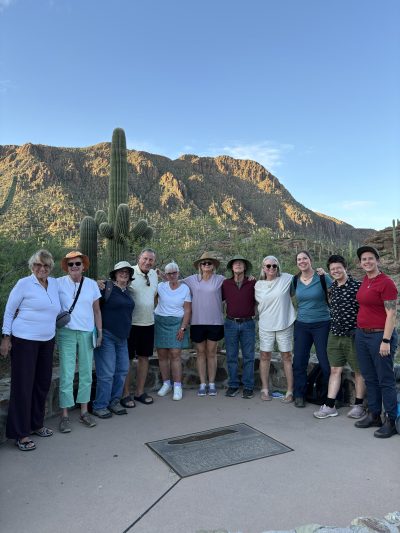
Pilgrims to the southern border.
This is the desert. It is a dangerous place.
People do not go into the desert unless they have to.
There is no water there, and without water we die.
There is no food there. Without food, we die.
When the wind blows, it changes the shape of the desert.
People get lost. Some never come back.
The desert is a dangerous place.
People only go there if they have to.
-Excerpt from the Godly Play story “The Ten Best Ways”
Godly Play stories about Abraham, Sarah, Moses, and the people of Israel in the desert all begin with this litany. It provides important context for kids who live far away from the harsh realities of a desert, helping them understand that the sandbox the story takes place in is much more than a playground toy- it is a piece of the desert, and the desert is a dangerous place.
Last year, St. Timothy’s in Centennial collaborated with other Episcopal parishes to support several families from Venezuela when they suddenly lost housing in Aurora. As we got to know these families, they trusted us with their stories. In January, we hosted an Epiphany dinner to raise awareness of the perils and plight of asylum seekers. More than a hundred parishioners listened as they shared their years-long journey to seek a new life in the United States.
The preface to desert stories rang in my ears as they shared how they crossed the treacherous Darien Gap, how difficult it was to navigate through Mexico, and how they were robbed several times along the way. They lost everything but kept walking. The desert is a dangerous place. People only go there if they have to. They encountered desert after desert on their journey. Some were literal deserts; others were abstract: hopelessness, loneliness, despair, faceless bureaucracy, discrimination, and human cruelty.
 Moved by their stories and the headlines of children and adults suffering the effects of ICE raids and inhumane detention, St. Tim’s began asking how we could be faithful to the Biblical commands of showing hospitality to immigrants and loving our neighbor as ourselves. The issue is so large, complex, and daunting. What can a faith community do in the face of such a big system? Where do we start?
A member of St. Tim’s, Desi Nicotera, approached me with an idea. His sister, Mick Nicotera, and Gale Hall, members of Church of the Apostles Episcopal parish near Tucson, created a curriculum inspired by Sacred Ground that centered on immigration on the southern US border. They called the class Sacred Journeys and are working with Episcopal Migration Ministries to roll it out nationwide. Before that could happen, they needed a handful of parishes to run a pilot and provide feedback.
We enthusiastically agreed to help and easily gathered a class of 12. Meeting for 10 class sessions, we learned about the history of US immigration policy, its evolution, and the impact on real human lives. We heard stories of immigrants navigating complex bureaucracy in the US to find safety from the “push factors” that forced them to leave the communities they knew. We learned that even when people do everything legally by the book, they still can end up in detention under inhumane conditions. We read a powerful book, Detained by David Esparanza and Gerardo Iván Morales. It is a story of a 14-year-old boy, his journey from Honduras to the US, and his detention in a camp in Texas where many children suffered under the family separation policy. We learned that migrant children are still being detained in unsafe and inhumane conditions in the US. The desert is a dangerous place. People only go there if they have to.
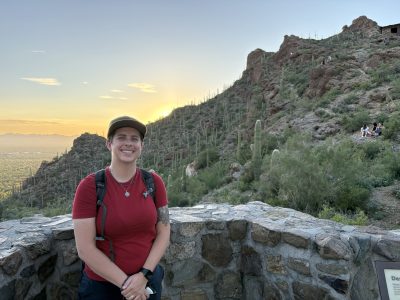
The Rev. Megan Worthman.
In addition to the Sacred Journeys, I led a pilgrimage to the southern border to continue our discernment for how the Holy Spirit is moving us to respond. In August, a delegation of 10 Episcopalians- nine from St. Tim’s and one from Ascension, Pueblo- traveled to Tucson and the border. We partnered with a public education non-profit called BorderLinks, whose mission is to learn about immigration by those who experience it directly.
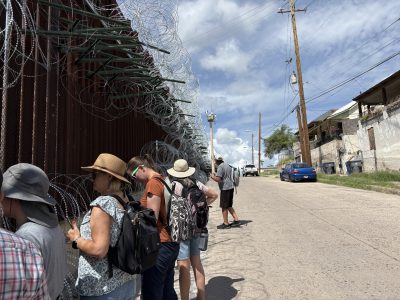
On the pilgrimage, we saw the heavily militarized border wall that bisects the town of Nogales. We walked in the desert where people risk their lives to find safety. We attended federal court where migrants were shackled and tried in criminal court for attempting to cross the border. We saw art made by migrants through Artisans Beyond Borders and witnessed bronze memorials of people who died in the desert. We learned that border crossing had not always been a criminal offense, and this process was created to humiliate and frighten people. We listened to a trans woman who was detained for eight months in a men’s detention center even though she was seeking asylum here and supported by a US legal team. The desert is a dangerous place. People only go there if they have to.
Reflecting on this year, I marvel at how the Holy Spirit opened doors at St. Tim’s to learn more about immigration. It’s no longer a political issue; it has a human face.
Christ calls us to break the power the desert has over the vulnerable by bringing food to the hungry, water to the thirsty, shelter to the homeless, and love to each person as our beloved sibling. Reflecting on our Sacred Journeys learnings and pilgrimage experience, St. Tim’s now feels called to support immigrants starting a new life in our community by supporting Field Elementary, a school in Littleton where over 90% of students are from immigrant families. We plan to help as volunteers, fundraise money for field trips, school supplies, the food pantry, working with the PTA to help support all students. We may not be able to effect change on a national scale easily, but we can act locally and make our home a little less of a dangerous place for our immigrant neighbors.
Leave A Comment